On this, World Meditation Day, a few random thoughts on practice:

  • You can’t do meditation wrong. There’s no success or failure.
  • In practicing meditation, we’re not trying to live up to some kind of ideal— quite the opposite. We’re just being with our experience, whatever it is…
  • Ordinary everyday life is meditation enough if we attend to it in the moment with simplicity, an open curious mind and without taking ownership of any of it.
  • The only way one really gets any of the most important benefits of meditation practice is by giving up on the notion that there are any benefits to meditation practice.
  • The heart of meditation is simply being interested in what is here now – being more interested in what is… rather than in what was, what will be, or what should be.

And finally…

What we’re really in the business of doing is helping people stay with the thoughts and feelings they are coming to meditation to escape.

— Ordinary Mind Zen teacher Barry Magid
The only possible place to get to, the only attainable perspective, the only condition one simply cannot help experiencing is the present moment whatever it is, however it is.

After years of practice and contemplation, trials and tribulations, an eventful life with its fair share of contentment and trauma – I still can’t better these three simple words to sum it all up…

This is it.

There’s a kind of wisdom that only arises automatically as time passes that no amount of learning or practice can induce. No shortcuts. There’s no substitute for the experience of life lived.

I’m fascinated by the visual tropes of spiritual materialism which almost always accompany or illustrate books, blogs, talks, retreats etc.

The visual language employed is mostly confined to some variation of pristine nature, evoking purity, clarity, beauty, colour and, above all, light. Lots of light. Sunrises, sunsets, the colour spectrum refracted through drops of dew, perfectly smooth polished stones, light reflected off mill pond still water.

All this beauty and perfection seems to perpetuate the myth of the spiritual goal as some eternally bright place out there somewhere in which we can dwell if we just follow this or that method.

Anyone who has really practiced any form of spiritual meditation, inquiry or contemplation for a significant period of time can attest to the vast spectrum of experience that constitutes one’s ongoing practice. To deny or avoid the inevitable and necessary murk and darkness is to deceive oneself and others. It is literally the case that without the dark there is no light.

Of all the traditions, I have always found myself drawn to Zen and its associated art seems entirely appropriate. Simple, ordinary and modest. Promising nothing yet evoking the inevitability of the present moment – whatever, however that may be.

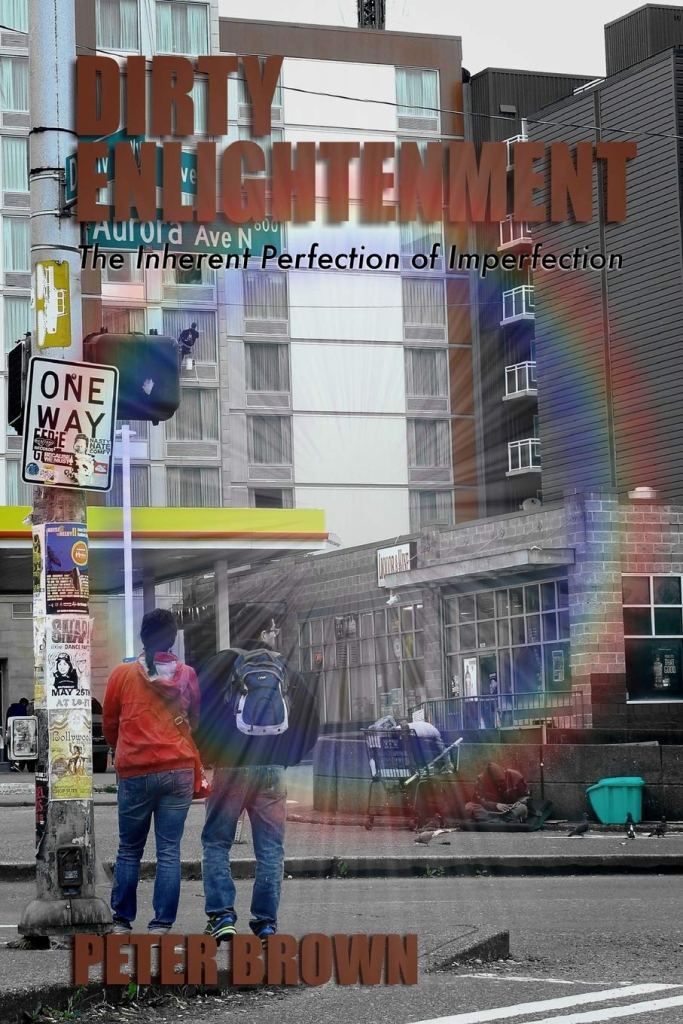
This refreshing book cover avoids most of the usual clichés.

Peter Brown’s Dirty Enlightenment.

I love the title for a start. The only gaffe is the circular rainbow motif but I appreciate the rest of the image – ordinary, everyday, and relatable.

Practice includes everything, nothing left out. If we are honest we can come to accept the entirety of our life which, if we’re being truthful, rarely features an impossibly radiant sunset or mirror still water, even metaphorically.

One lesson Zen practice teaches us is that without the constraints that we place upon ourselves of trying to control outcomes, we find ourselves in the natural flow of life. We regain the sense of being part-of rather than separate-from and we can relax…

easy